About Pasang Emas
Pasang is a traditional game of Brunei.
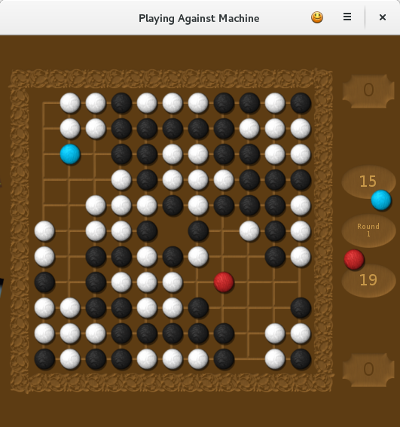
In this game, black and white tokens are arranged on a playing board, forming a pattern. There is a catalogue of more than 30 different patterns. Many of these patterns resemble embroideries commonly seen on kain songket or kain tenun, Brunei's traditional cloth.
Two players take turn capturing these tokens, scoring 1 point for each black token and 2 points for each white one. The game ends when the board is empty, or when a player runs out of moves.
Pasang is commonly played during celebrations of royal weddings and the annual birthday festival of the Sultan of Brunei.
Pasang Emas brings this unique game to your computer.
Features
Virtual opponents
Pasang Emas gives you several virtual opponents that will tirelessly play against you. An absolute beginner may like to play against the easy going Cakoi while a seasoned master may like to compete against the unforgiving Kambayau. (To be accurate, Pasang Emas gives you 1000 different virtual opponents. Most are nameless and are identified only by numbers).
Demo
In addition to the Help menu, you can learn the game by watching a virtual player compete against another.
Themes
Pasang Emas can be themed. There is a separate theme package available. In addition, if you are artistic, you can easily create your own theme.
Multilingualization
Pasang Emas is multi-lingual. We consider Malay to be the primary language for Pasang Emas, though our development tools insist that English is the primary language.
Translation to Arabic is partial, and whatever there currently is needs to be polished.
Translations to other languages are welcome. (Sorry, no CVS yet).
Supported platforms
Pasang Emas is developed and tested on Debian stable. We restrict our choice of software libraries to those found in the stable repository. Given the conservativeness of Debian stable, Pasang Emas should compile and run on practically all the latest Linux distros, unless there are some drastic changes in the library interfaces.
Pasang Emas should also compile and run on BSD and Hurd, though we haven't confirmed this yet.
Acknowledgements
Mohd Abdoh bin Haji Awang Damit of Jabatan Kokurikulum, Brunei, first suggested the idea of developing a computer program to play pasang. Jabatan Muzium-Muzium Brunei published a book, Mari Bermain Pasang, which is a great source of reference. Unfortunately, the book is vague and incomplete in some places. Pg Haji Ismail bin Pg Ibrahim of Jabatan Muzium-Muzium Brunei, helped clarify the rules of pasang, lent a pasang set (a board, tokens, and pattern cards), and verified an initial implementation of Pasang Emas.
Contact Address
Change the X's to dots and remove the Q's:
jaidiQQ@fosXubdXeduXbnnorjaidiQQ@gmailXcom
![Pasang Emas icon [icon]](pasang-emas.png)